
In the wee hours of the morning, long before the sun rises, Filipino neighborhoods echo the same sound: a rubber horn honking “potpot,” a signal that the bread vendor has arrived to deliver baskets of freshly baked bread, mostly pan de sal or monay.
By 5 a.m., lines at the nearby panaderyas, or local bakeries, are already forming as stacks of freshly baked Filipino breads are displayed abundantly in transparent glass cases. The scent of just-baked pan de sal fills the air as the morning crowd totes brown paper bags filled with the day's breakfast.
Some traditions may have changed, but these morning loaves still hold a piece of our history and culture.
The first Filipino bread
The earliest version of bread in the Philippines goes back to the colonial times.
Antonio Pigafetta, a Venetian scholar and explorer from the historic 1521 Spanish expedition, first reported that “some kind of bread” was being made and eaten by natives. He described it as “wooden bread made from a tree resembling the palm,” which was later called saghu, now called sago.
Sago was also documented in 1687 by William Dampier, an English explorer, when he visited Mindanao and discovered the natives consuming a variation of sago bread made from nipa palm. It was pounded, then soaked in water, strained, and dried, resulting in a starchy mass used to create the earlier versions of bread, with a texture similar to rice cakes.
It wasn’t until the 16th century during the Spanish colonization that wheat-based baking was first introduced to the Philippines. Because the Philippines wasn’t producing wheat back then, the Spaniards sourced wheat from Chinese merchants with a primary goal of baking Eucharistic bread (hostia) for Catholic masses. Eventually, the practice started spreading into local communities and became the roots of local bakeries, or what we call today as panaderya.
The first panaderia was introduced back in 1625 in Intramuros, Manila, with the same purpose: to supply bread for communion. It was managed by the Spaniards and Chinese laborers who tried to recreate the French baguette, which eventually led to the invention of the first version of pan de sal, or what we call today as pan de suelo.
Tinapay and the history of pan de sal
Bread, or tinapay as we call it, was first recorded in Cebu as tinapai. It originally meant “a certain kind of rice cake,” considering the earliest versions of bread had a similar texture to rice cakes. Later, the Spaniards began using the word tinapay to refer to the Sacramental bread, hostia, until it was eventually used to call all other wheat-based bread.
With a long history of colonization, most of the classic Filipino bread we know today carries Spanish names and American influence, with the most common one being the many “pan de” varieties. "Pan" directly translates to bread, "de" translates to of, meaning “bread of.”
Before the first pan de sal was born, there was pan de suelo—a baguette-style bread that was first introduced by the Spaniards. It directly translates to “floor bread,” as it is baked on the floor of a pugon, a traditional wood-fired brick oven, resulting in a thicker and harder crust.
Then, during the 1900s, when the Americans introduced affordable wheat, pan de suelo evolved into a softer and doughier bread, which we now call pan de sal.

Pan de sal directly translates to "bread of salt", as the primary ingredient of the earlier versions was salt. Over time, it was eventually adapted to the Filipino taste as it shifted to the sweeter side when sugar became cheaper and more readily available.
Modern pan de sal has seen many varieties, often with flavors deeply rooted in history and culture. Malunggay (moringa) pan de sal was born out of the desire to feed Filipinos a healthier alternative and reduce the crisis of malnutrition. Several years later, during a global pandemic, another version made rounds on the internet—ube (purple yam) pan de sal—one of the many food trends that went viral while the whole world was on lockdown.
While these variations of pan de sal have flavors infused in the ingredients, the traditional way Filipinos eat plain pan de sal is slicing it open and adding palaman (fillings) like cheese, peanut butter, jam, chocolate spread, or more savory fillings like tuna or corned beef.
Classic Filipino breads
While the origins of pan de sal have birthed many other varieties of Filipino bread over the years, there is one bread aptly called “mother of all Filipino breads,” and it is not pan de sal.
Pan de monja, or commonly known as monay, is one of the most basic bread types in the Philippines. This dense bread roll is known for its slightly sweet and milky flavor with its signature crease in the middle. The dough, made of flour, milk, sugar, and salt, is also used as a base for other variants like putok or star bread, and pinagong. While they share the same dense texture, putok offers a sweeter taste, while pinagong is on the milkier side. Putok also features a more complex star-shaped scoring than monay, resembling an “explosion,” while pinagong has a pagong-like (turtle) scoring.
The distinct artistry of Filipino bakers with scoring didn’t stop with these three variants. We also have kababayan, a local muffin made to resemble the shape of a salakot—a traditional Filipino dome-shaped hat used as protection from the sun or rain. It has a signature yellow color and features a soft, moist, and chewy texture similar to sponge cake.
As a country widely known for its natural resources, it is no surprise that Filipino bakers were also greatly influenced by our own tropical produce. Take pan de coco, or coconut bread. This soft and sweet roll is filled with bukayo, a chewy caramel-like filling made with grated or shredded coconut and simmered in brown sugar or muscovado.
Ironically, while most of our breads came from the Spaniards, pan de Kastila, or Spanish bread, was the one purely made by Filipino bakers. Most theories suggest that the bread was a hybrid mix of the classic pan de sal and the beloved sweet ensaymada; only this time, it is rolled into an oblong. The bread has a sweet filling made with breadcrumbs, butter or margarine, and brown sugar. Similarly, we have pan de regla or kalihim, a sweet bread with bright red pudding filling made from stale bread, milk, sugar, eggs, butter, and vanilla.
Filipino bread favorites within your reach
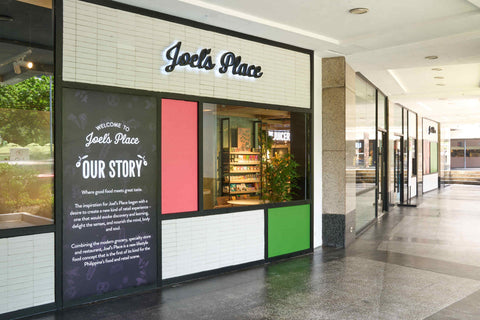
At Joel’s Place, we love celebrating Filipino food and its rich history, culture, and tradition. You can find classic panaderya favorites in-store:
- Plain pandesal – Traditional Filipino pan de sal that is soft, fluffy, and slightly sweet.
- Ube pandesal - Classic pan de sal filled with sweet purple yam (ube) and cheddar cheese.
- Corned beef pandesal - Classic pan de sal filled with savory corned beef.
- Tuna pandesal - Classic pan de sal stuffed with a savory tuna filling.
- Spanish bread - A Filipino bread roll with a sweet and buttery filling coated in breadcrumbs.
- Pan de coco - A soft and fluffy Filipino bread roll filled with sweet coconut filling.
Beyond sustenance
The Philippines may be known as a huge rice-growing nation, but our breads also carry an equally rich, centuries-long history of influences. Every humble tinapay we eat reflects stories of the past that helped shape our culture and people today. What was once a form of sustenance that nourished Filipino communities has grown into a symbol of comfort and emotional connection, reflecting the importance of culture and tradition in the country.